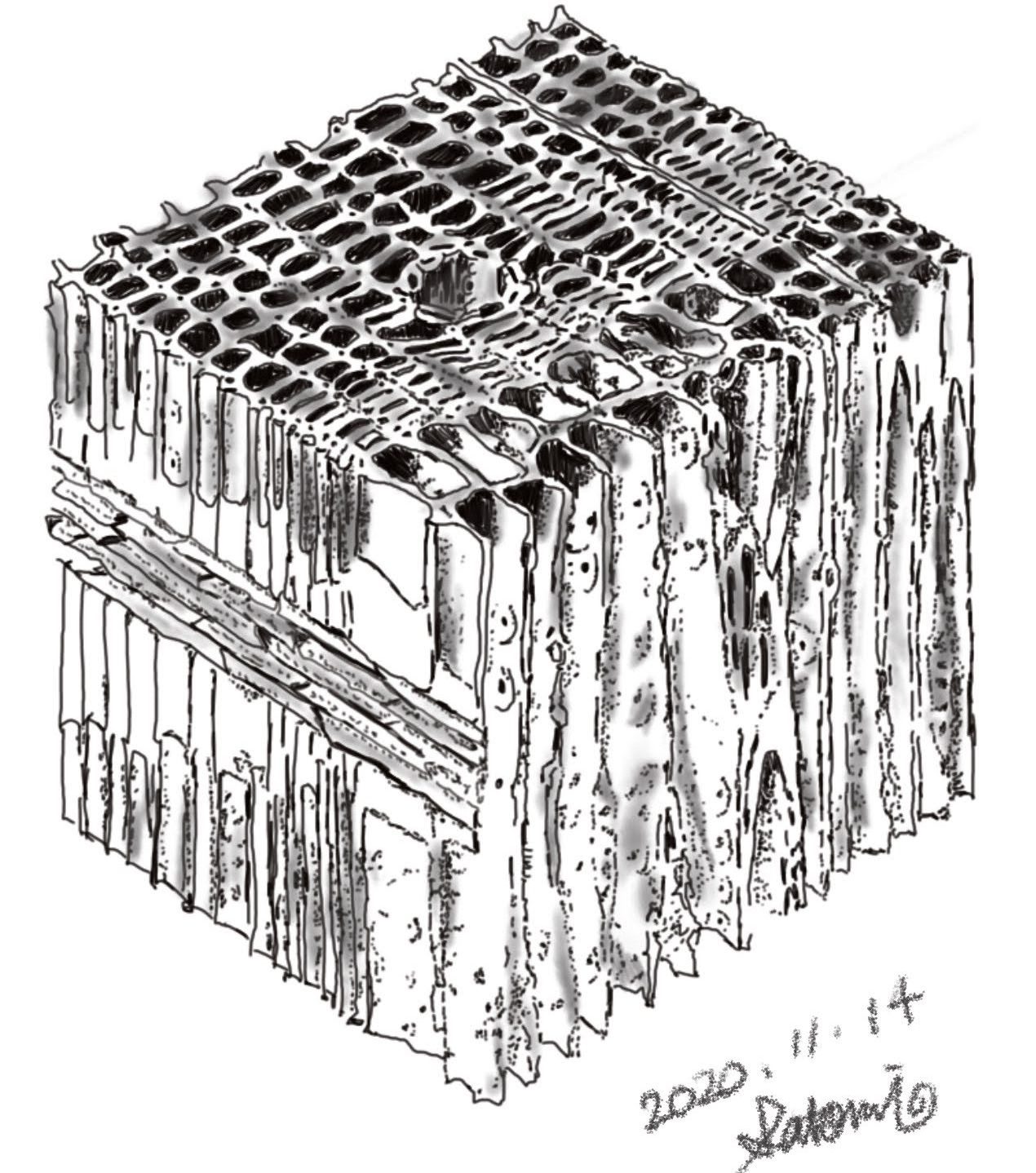

2023年1月、私はフィンランドを訪れました。これは令和4年度「知」の集積による産学連携推進事業の一環である「バイオエコノミー推進人材活動支援事業」の取り組みの一部であり、フィンランドにおけるバイオ産業およびバイオ研究の実態を調査する視察でした。
この経験は、私自身の研究におけるターニングポイントとなりました。本稿では、フィンランド視察を通じて私が得た気づき、そしてバイオエコノミーに対する考え方の変化について綴ります。
In January 2023, I visited Finland as part of the Human Resource Development Program for Promoting the Bioeconomy under the FY2022 “Knowledge Integration” Industry-Academia Collaboration Promotion Project. The purpose of this visit was to survey the current state of the bioindustry and bio-research in Finland.
This experience became a major turning point in my own research journey. In this article, I will share the insights I gained through the study tour in Finland and how it transformed my perspective on the bioeconomy.
1. バイオエコノミーとは何かー What Is the Bioeconomy?
バイオエコノミーは、化石資源依存から脱却し、持続可能なバイオ資源を基盤とする経済活動へとシフトする理念です。しかし、いざその本質を掘り下げようとすると、抽象度が高く、言葉にしづらい難しさを感じます。
そこで私がたどり着いたのが、サステイナビリティ学(持続性科学)という概念でした(図1)。これは、東京大学第28代総長であり、現・三菱総合研究所理事長である小宮山宏氏によって提唱された新しい学術領域です。人間活動と自然環境の調和を目指し、複雑で長期的な社会課題に俯瞰的・統合的に挑む学問体系。それが持続性科学です。
The bioeconomy is a vision for shifting from dependence on fossil resources toward an economy based on sustainable biological resources. However, when I tried to delve into its essence, I found it challenging to define in clear terms due to its high level of abstraction.
This led me to the concept of sustainability science (Figure 1), a new academic field proposed by Dr. Hiroshi Komiyama, the 28th President of the University of Tokyo and current Chairman of Mitsubishi Research Institute. Sustainability science seeks to harmonize human activity with the natural environment, tackling complex and long-term societal issues through an integrated and holistic approach.
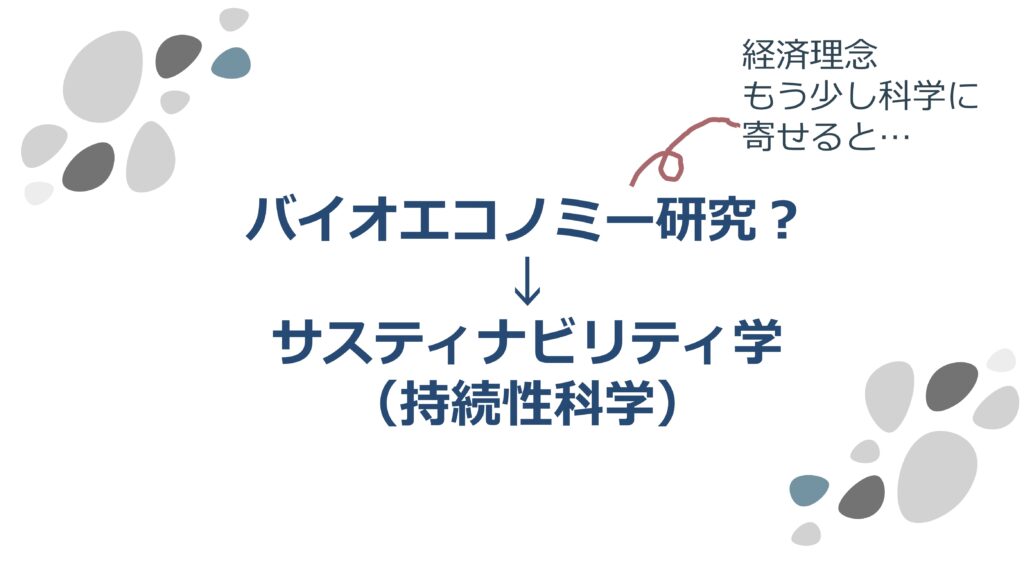
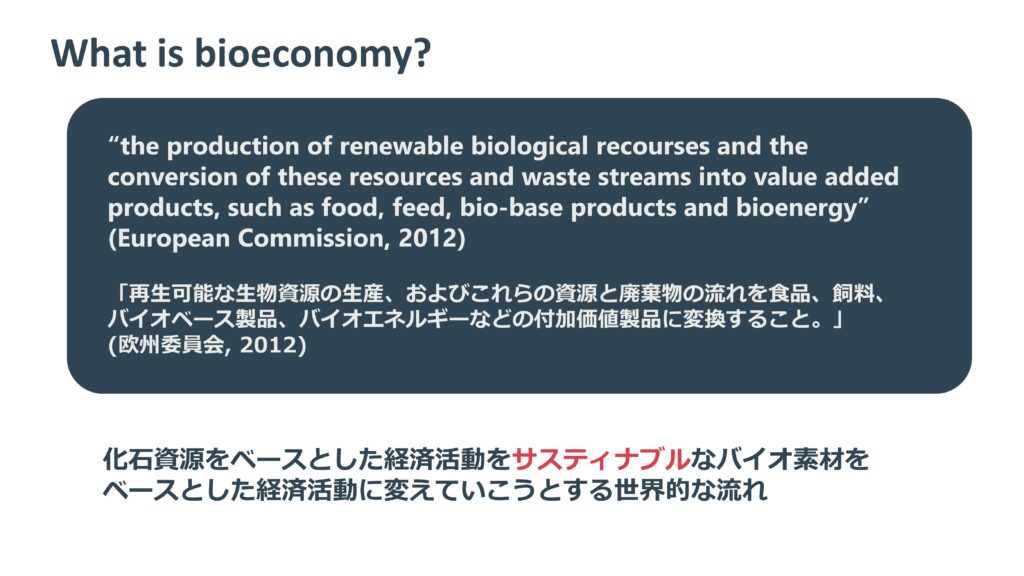
図1 バイオエコノミー研究とは何か
2.持続型社会に向けた課題ーChallenges Toward a Sustainable Society
持続型社会の実現に向けて必要とされる行動群を図2に示しました。これらの行動群は特定の分野に限定されるものではなく、科学の既存の分類体系を超えて、平面全体に広がっています。つまり、持続可能性問題の解決において、特定分野が突出して重要であるとは言えず、分野横断的な、学際的なアプローチが不可欠であることが分かります。
バイオエコノミーの概念は国ごとにさまざまな解釈が存在しますが、一般的に「化石資源に依存した経済活動を、持続可能なバイオ資源に基づく経済活動へと転換しようとする世界的な潮流」と捉えることができます。この視点から見ると、バイオエコノミーはまさに持続性科学の射程に収まるものであり、両者は深く結びついていると考えられます。
Figure 2 outlines the range of actions necessary for achieving a sustainable society. These actions are not confined to any single field but instead extend across the entire plane, transcending traditional academic classifications. In other words, no single discipline can claim primacy in solving sustainability issues; instead, interdisciplinary and cross-sectoral approaches are essential.
The concept of the bioeconomy varies from country to country, but it can generally be understood as a global movement to shift from fossil resource-dependent economic activities to those based on sustainable biological resources. From this perspective, the bioeconomy falls squarely within the scope of sustainability science, and the two are deeply interconnected.
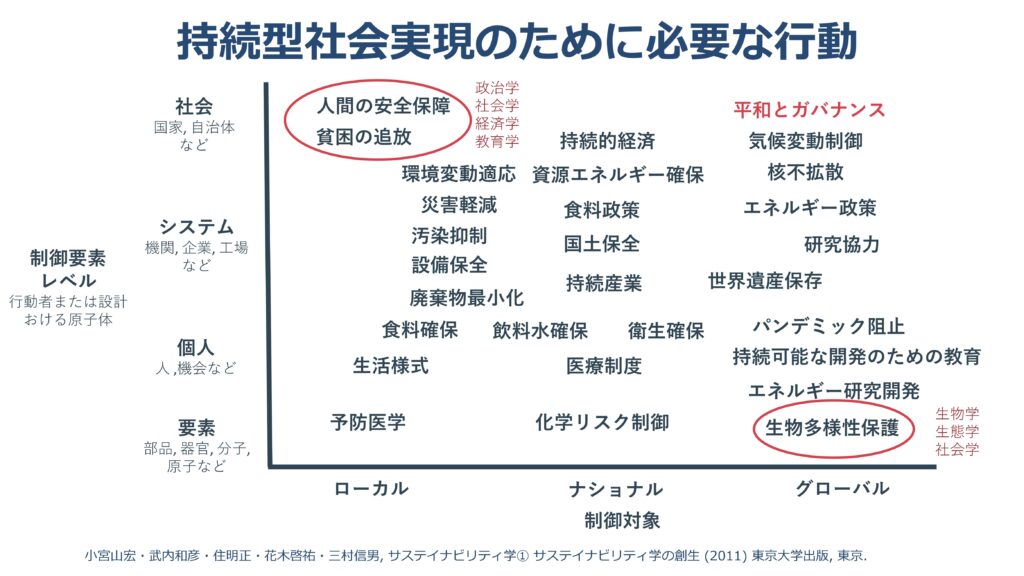
図2 持続型社会実現のために必要な行動1)
3.フィンランドでのディスカッション体験を踏まえて
ーReflections on Discussions in Finland
フィンランド視察の際、LUKE(フィンランド自然資源研究所)と東フィンランド大学とのディスカッションの場で、図3に示すような概要図に出会いました。イラストは非常に美しく印象的でしたが、私は一目ではその内容を理解することができませんでした。
なぜ直感的に理解できなかったのか。その理由を考えたとき、私がこれまで親しんできた現代科学と、フィンランドのバイオエコノミーを支える持続性科学の体系との違いに行き着きました。両者のアプローチや視点の違いが、私にこの戸惑いをもたらしたのだと感じたのです。
During the study tour in Finland, I had the opportunity to participate in discussions with LUKE (Natural Resources Institute Finland) and the University of Eastern Finland. It was there that I encountered a conceptual diagram like the one shown in Figure 3. The illustration was both beautiful and striking, yet I couldn’t grasp its meaning at first glance.
Reflecting on why it wasn’t immediately intuitive to me, I realized that the difference lay in the scientific frameworks. It became clear that the contemporary science I had been familiar with and the sustainability science underpinning Finland’s bioeconomy were fundamentally different. I sensed that the divergence in approaches and perspectives between the two was the source of my initial confusion.
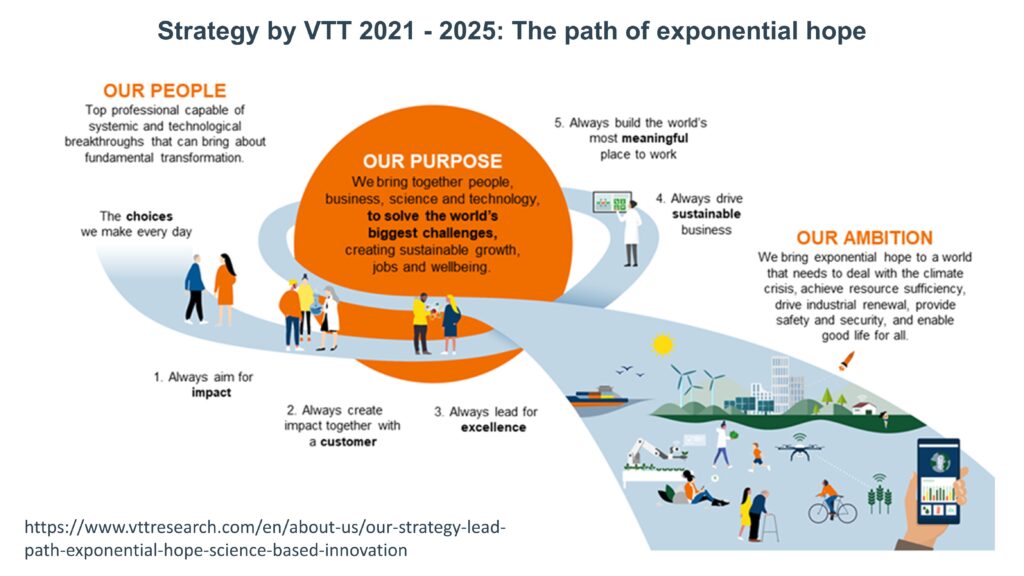
図3 LUKEの戦略と価値観
4.現代科学と持続性科学の相違点
ーDifferences Between Contemporary Science and Sustainability Science
これはあくまで私の主観ですが、フィンランドでは広く俯瞰するスタイルの研究が主流であり、日本では、狭く専門性を深めていく研究スタイルが中心であるという印象を受けました。図4を参照すると、日本では現代科学的な思考が色濃く、フィンランドでは持続性科学的な思考が根づいているように感じられます。
現代科学は、特定の専門分野を設定し、その内部で知識を体系的に蓄積してきました。知識量が増大するにつれ、さらに細分化された専門領域が形成され、知識の管理体系が構築されていきます(文献2)。このプロセスは、現状を分析し、未来を予測するフォアキャスト思考に基づいており、重視されるのは現実を理解するための知識です。最終的に期待されるのは、人類の繁栄という成果です。
これに対して、持続性科学は、個々の要素間の関係性を観察し、それを制御することを目的としています。地球上のあらゆる存在の緩やかな変化を捉え、段階的に調査を進めるアプローチです。重視されるのは、行動のための知識であり、期待されるのは地球の持続性です。このアプローチは、仮説的推論(アブダクション)に基づくバックキャスト思考によって推し進められます。
This is purely my personal observation, but I got the impression that in Finland, research tends to take a broad, holistic perspective, whereas in Japan, the focus is more on narrowing down and deepening specialized fields. Referring to Figure 4, it seems that contemporary scientific thinking is more dominant in Japan, while sustainability science thinking has taken root in Finland.
Contemporary science has developed by establishing specific disciplines and systematically accumulating knowledge within them. As the volume of knowledge has increased, these disciplines have become further subdivided, creating a complex system for managing knowledge (Reference 2). This process is based on a forecast-oriented approach that analyzes the present and predicts the future, with the primary emphasis on knowledge for understanding reality. Ultimately, the expected outcome is the prosperity of humankind.
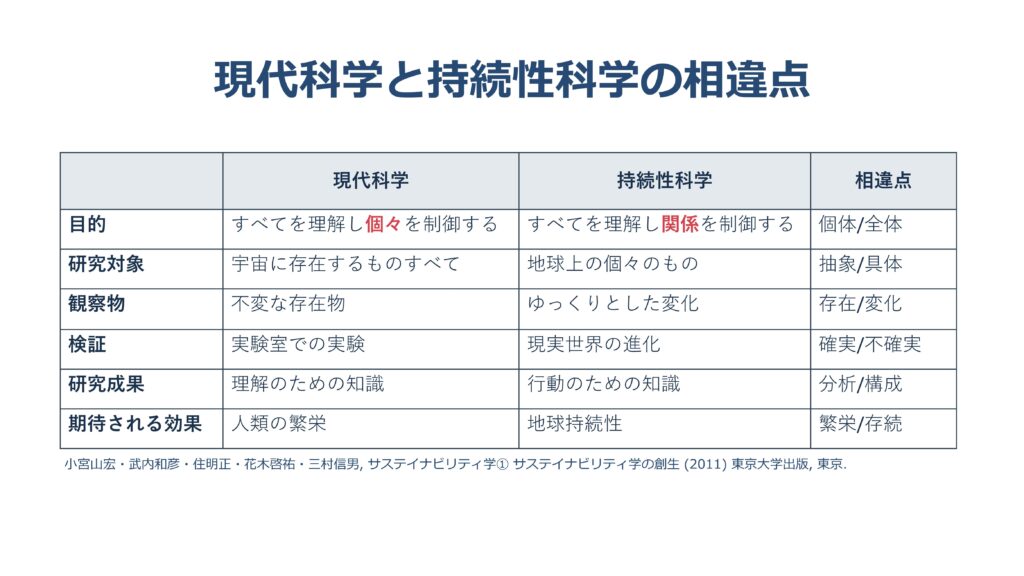
図4現代科学と持続性科学の相違点
5.持続性科学は統合科学の一つであるーSustainability Science as an Integrative Science
現在の科学体系が確立される以前、各地にはローカルな現実に根ざした具体的な知識が存在していました。いわゆる伝統的知識、あるいは土着知識と呼ばれるものです。
土着知識は、次の三つの要素が一体となったものでした(文献1)
- ある事実が存在する
- その事実をどのように利用するか
- 利用した結果が人間にどのような意味をもたらすか
この三位一体の知識は、近代科学の発展の過程で分化し、それぞれ理学的知識、工学的知識、社会学的知識として体系化されていきました。
持続性科学が目指すのは、この分化した知の再統合です。複雑な課題に対処するために、かつて土着知識が備えていた統合的な視点を現代に甦らせることが求められているのです(図5)。
Before the establishment of the modern scientific system, local communities around the world possessed concrete knowledge rooted in their immediate realities. This is what we now refer to as traditional knowledge or indigenous knowledge.
Indigenous knowledge embodied a trinity of three elements (Reference 1):
- The existence of a certain fact,
- How that fact could be utilized, and
- The significance that the utilization of the fact held for human life.
Over time, this trinity of knowledge was separated during the development of modern science and systematized into three distinct domains: natural science, engineering science, and social science.
What sustainability science aspires to is the reintegration of this fragmented knowledge. To tackle complex challenges, we are being called upon to revive the integrative perspective once inherent in indigenous knowledge (Figure 5).
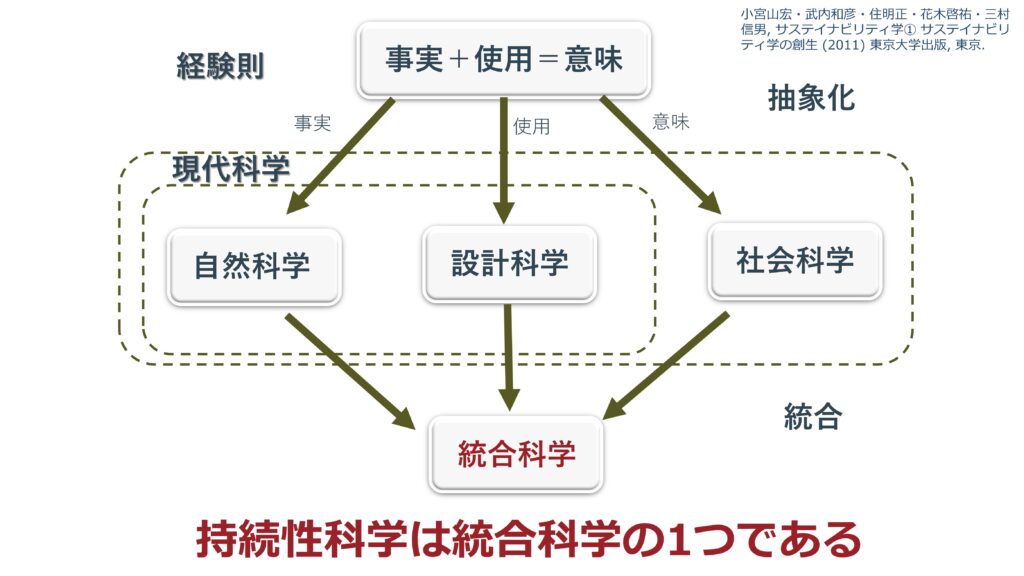
図5 持続性科学の立ち位置1)
6.日本は土着知識と課題の宝庫!?ーJapan: A Treasure Trove of Indigenous Knowledge and Challenges?
私は、日本には多種多様な土着知識が存在していると考えています。その根拠として、寺田寅彦が随筆『日本人の自然観』(青空文庫)に記した一節を紹介したいと思います。
日本の自然界は気候学的・地経学的・生物学的その他あらゆる方面から見ても時間的ならびに空間的にきわめて多様多彩な文化のあらゆる段階を具備し、そうした多様の要素のスペクトラが、およそ考えられ得るべき多種多様な結合をなしてわが邦土を色どっており、しかもその色彩は時々刻々に変化して自然の舞台を絶え間なく活動させているのである。
寺田寅彦, 日本人の自然観, 青空文庫より
日本列島は、亜熱帯から亜寒帯に至るまで、さまざまな気候帯を抱えた国土を有しており、そこにこそ日本の大きなアドバンテージがあると私は考えています。環境の多様性が高いということは、地方ごとに固有の課題が存在し、それに根ざした土着知識が豊かに蓄積されていることを意味します。
もちろん、多様性が高まるほど、知識は現代科学の階層構造の中で細分化され、再統合の難易度も上がっていきます。しかし、この多様性を逆に活かすことができれば、日本は複雑な課題に先進的に取り組むモデルとなり得ます。いわば、日本は「小さな地球」とも呼べる存在であり、持続性科学の実践において極めて魅力的なフィールドだと言えるでしょう。
I believe that Japan harbors a rich diversity of indigenous knowledge. As a foundation for this belief, I would like to introduce a passage from Torahiko Terada’s essay “The Japanese View of Nature” (available via Aozora Bunko):
“From the perspectives of climatology, geoeconomics, biology, and beyond, Japan’s natural environment encompasses every conceivable stage of cultural development across both time and space. The spectra of these diverse elements combine in myriad ways to color our land, with the hues shifting moment by moment, creating a ceaselessly dynamic stage of nature.”
— Torahiko Terada, The Japanese View of Nature (Aozora Bunko)
Stretching from the subtropical to subarctic zones, the Japanese archipelago possesses an exceptionally diverse range of climates. I see this environmental diversity as one of Japan’s greatest advantages. High environmental diversity implies the existence of unique, localized challenges—and with them, a wealth of indigenous knowledge embedded within each region.
Of course, as diversity increases, knowledge tends to become more fragmented within the hierarchical structure of modern science, making reintegration more difficult. However, if we can leverage this diversity, Japan could become a pioneering model for addressing complex challenges. In a sense, Japan could be seen as a “small Earth,” offering an extraordinarily attractive field for the practice of sustainability science.
7.持続性科学の特徴ーKey Characteristics of Sustainability Science
持続性科学の特徴を改めて整理しておきましょう(図6)。特に重要なキーワードは、統合化された知識、四次元レンズ(時間軸を含む視点)、そしてアブダクション(仮説的推論)です。
これらの概念は、単なる理論にとどまらず、現代社会が直面する複雑な課題に対して実践的な指針を与えてくれるものです。そして、バイオエコノミーの実現に向けても、これらの視座は極めて重要な役割を果たすと私は考えています。
Let us revisit the key characteristics of sustainability science (Figure 6). The most important keywords are integrated knowledge, the four-dimensional lens (a perspective that includes the dimension of time), and abduction (hypothetical reasoning).
These concepts are not merely theoretical; they offer practical guidance for addressing the complex challenges faced by modern society. I believe that these perspectives will also play an essential role in the realization of the bioeconomy.
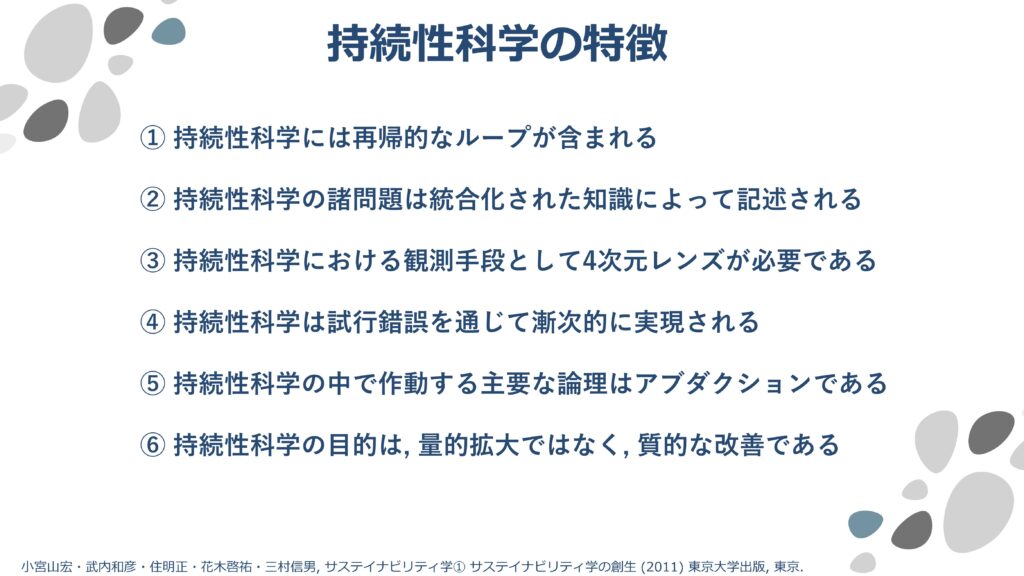
図6 持続性科学の特徴1)
8.VTTのバイオエコノミー関連プロジェクトの報告書ーReport on VTT’s Bioeconomy-Related Projects
VTT(フィンランド技術研究センター)の建物内に置かれていた報告書(パンフレット)の一部を図8に示します。そこでは、各研究テーマが基礎研究から社会実装までのどの段階に位置しているかが一目で分かるように整理されていました。
さらに、市場投入までに要する時間も見積もられており、タイムスケールを強く意識した設計となっていることが読み取れます。多様な研究プロジェクトを共通の評価軸で可視化・評価している点は、複雑な課題を統合的に管理していく上で非常に有効なアプローチであると感じました。
Figure 8 shows part of a report (brochure) displayed inside the building of VTT (Technical Research Centre of Finland). The research themes were organized in a way that made it immediately clear where each project stood along the spectrum from basic research to societal implementation.
Moreover, the time required to bring each project to market was also estimated, reflecting a strong awareness of the time scale involved. I found it particularly effective that diverse research projects were visualized and evaluated using a common framework—an approach that seems highly useful for the integrated management of complex challenges.
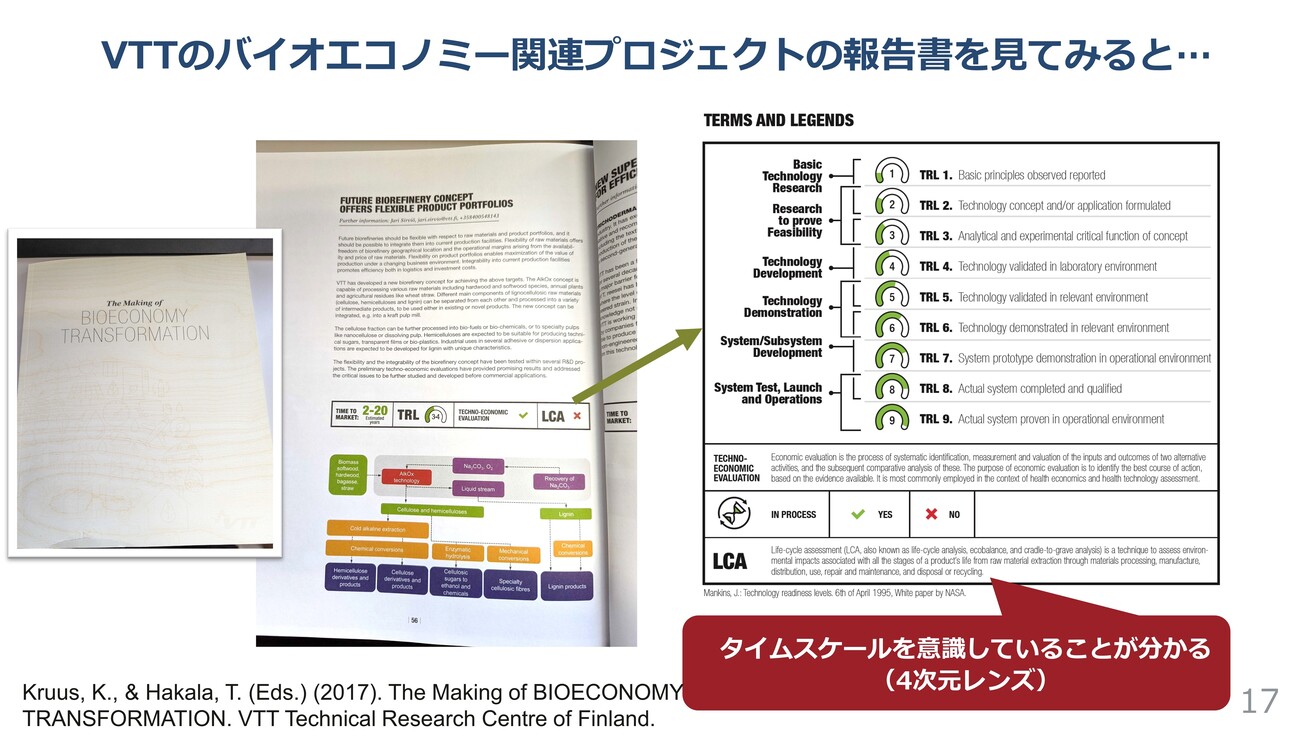
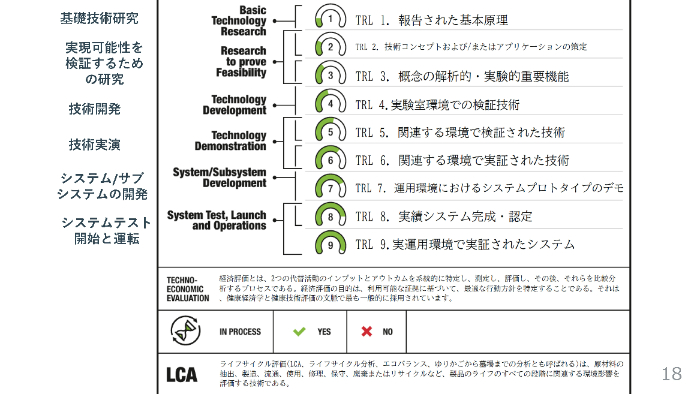
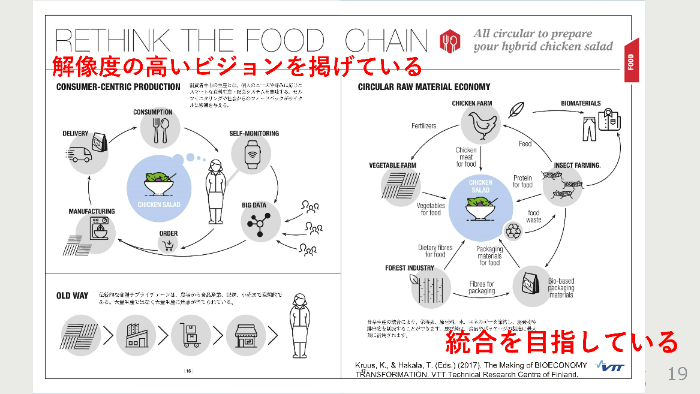
図7 VTTにおけるプロジェクトの報告書2)
9.フィンランドでオープンディスカッションを経験ーExperiencing Open Discussions in Finland
私はこれまで、オープンディスカッションというものをほとんど経験したことがありませんでした。しかし今回、フィンランドで初めてその場に身を置く機会を得ることができました。
バイオエコノミーの実現に向けて、各自が自由に意見を交わし、それが連鎖的に新たなアイデアを生み出していく様子は非常にエキサイティングで、充実した時間を過ごすことができました。
こうした議論を可能にしている背景には、心理的安全性の高さがあると感じます。多様な考えを受け入れる柔軟な空気こそが、チームで研究を進める上で不可欠な土壌であり、フィンランドはこの点においても一歩先を行っているという印象を強く受けました。
Until this visit, I had rarely experienced what is known as an open discussion. However, during my time in Finland, I finally had the opportunity to immerse myself in such an environment.
As each participant freely exchanged ideas toward the realization of the bioeconomy, a chain reaction of new insights and innovations emerged. It was an incredibly exciting and fulfilling experience for me.
What enables these discussions, I believe, is a high level of psychological safety. The flexible atmosphere that embraces diverse perspectives forms a fertile ground for team-based research. I strongly felt that Finland is ahead of the curve in fostering such an environment.
10. フィンランドは自然を意識し魅せるーFinland: A Nation that Embraces and Showcases Nature
図10〜13に示したのは、今回のフィンランド視察中に訪れた、特に印象的だった建築物です。いずれも木材や自然素材を巧みに用いた洗練されたデザインで、空間や光の使い方にも細やかな工夫が施されていました。
フィンランドの人々は、自然を単なる背景としてではなく、意識的に取り込み、その特性を最大限に活かす術に長けているのかもしれません。自然との共生をデザインにまで昇華させる彼らの感性に、深い感銘を受けました。
Figures 10 through 13 show some of the most striking buildings I visited during the study tour in Finland. Each structure featured sophisticated designs that skillfully incorporated wood and other natural materials, with careful attention paid to the use of space and light.
The Finnish people seem not to treat nature merely as a backdrop, but rather to consciously integrate it, maximizing its inherent qualities. I was deeply impressed by their sensibility—one that elevates coexistence with nature into an art form through design.
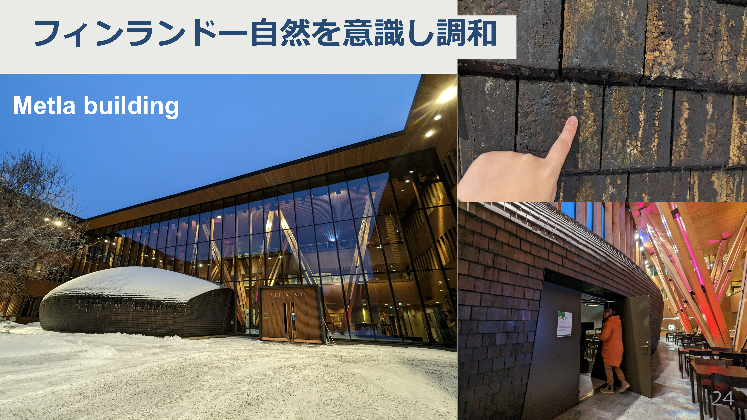
図8 Melta building@Joyence
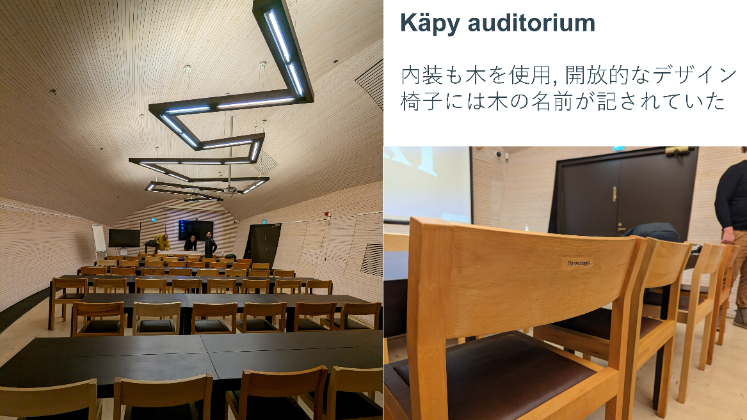
図9 Melta building内の講堂
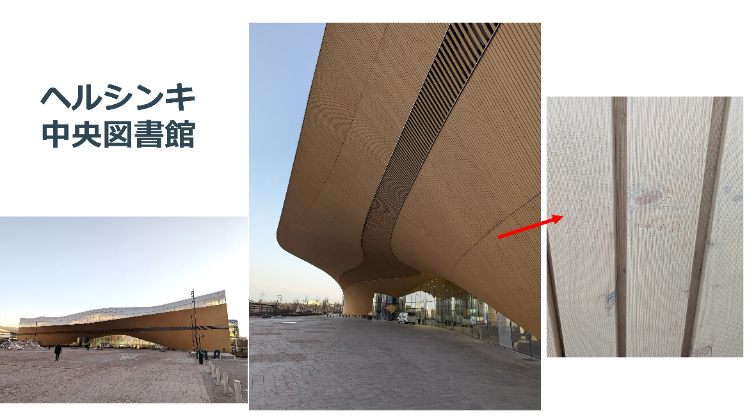
図10 ヘルシンキ中央図書館
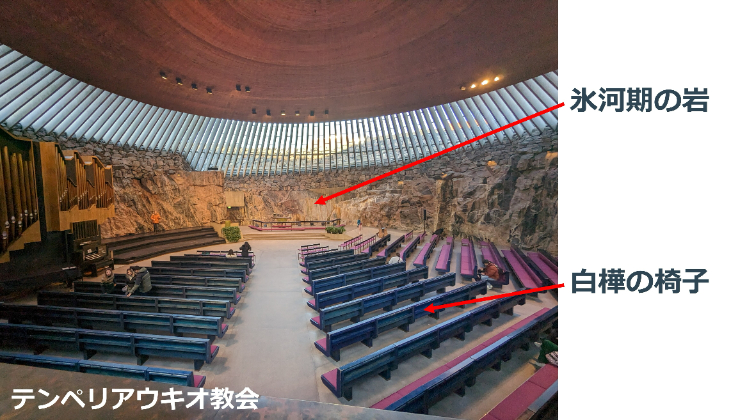
図11 テンペリアウキオ教会
11. 日本は自然が日常に溶け込んでいるーIn Japan, Nature Is Woven into Daily Life
一方、日本はどうでしょうか。私は、日本もフィンランドに勝るとも劣らない、自然と調和する文化を持つ国だと考えています。松尾芭蕉の『笈の小文』(図12)にも記されているように、日本では自然は特別な存在ではなく、日常の風景に溶け込み、あって当然のものとして受け入れられてきました。
日本文化、そして自然災害の多さを踏まえると、日本人は自然を慈しみつつ、同時に畏怖するという独自の感性を育んできたといえるでしょう。西欧のように自然を制御の対象とするのではなく、適応の対象としてきた点が特徴的です。
しかし、バイオエコノミーの実現には、単なる適応ではなく、能動的かつ主体的な行動が求められます。
先にも述べた通り、日本には多様な知識が蓄積され、多様な課題が潜在しています。いま求められているのは、西欧のモデルをなぞるのではなく、日本固有の文脈に適した形でバイオエコノミーを実現する道を模索することです。それこそが、日本のバイオエコノミー研究に課せられた使命だと、私は考えています。
What about Japan? I believe that Japan, too, possesses a culture of harmony with nature that rivals, if not surpasses, that of Finland. As described in The Records of a Travel-Worn Satchel (Oi no Kobumi) by Matsuo Bashō (Figure 12), nature in Japan has not been treated as something special, but rather has been seamlessly integrated into everyday life, embraced as an inherent part of the landscape.
Given Japan’s cultural background and frequent natural disasters, the Japanese people have developed a unique sensibility—one that cherishes nature while simultaneously holding it in awe. Unlike Western traditions that often view nature as something to be controlled, Japan has historically approached nature as something to be adapted to.
However, the realization of the bioeconomy requires not just adaptation, but proactive and intentional action.
As mentioned earlier, Japan possesses a rich accumulation of diverse knowledge and faces a wide array of latent challenges. What is needed now is not simply to replicate Western models, but to seek a path toward realizing the bioeconomy that is suited to Japan’s unique context. I believe that this is the mission entrusted to Japan’s bioeconomy research.
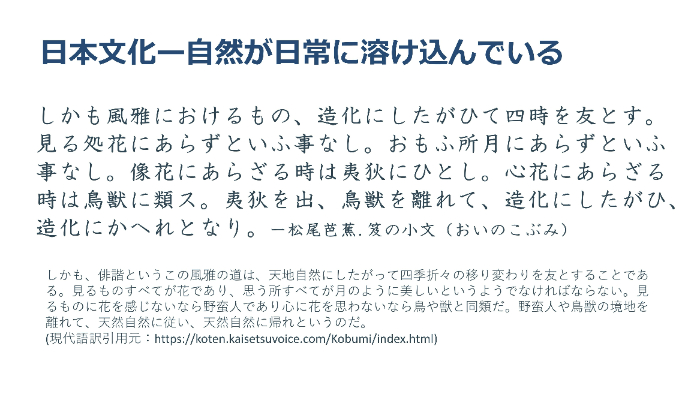
図12 松尾芭蕉の笈の小文引用
12. ネクストアクションーNext Action
今回のフィンランド視察を通じて、フィンランドのバイオエコノミーの先進的な取り組みだけでなく、日本のバイオエコノミー研究が持つ潜在的な魅力にも改めて気づかされました。
若手研究者は、つい業績を積み上げることに意識が向きがちです。しかし、視野を世界に広げることで、これまでにない新たな視座を得ることができます。国際学会にとどまらず、海外視察やオープンディスカッションといった多様な経験の場を提供することは、今後の日本を支える人材育成の観点からも極めて重要だと強く感じました。
私自身のネクストアクションとしては、次の三つを掲げています。
- 若い世代へのバイオエコノミーの普及
- オープンディスカッションができる環境づくりの模索
- イベントへの積極的な参加と新たな企画の立案
これらを通じて、未来を担う若き研究者たちが、持続可能な社会づくりの中心となれるよう、私も歩みを進めていきたいと考えています!
Through this study tour in Finland, I not only witnessed the country’s advanced initiatives in the bioeconomy, but also gained a renewed appreciation for the latent potential of bioeconomy research in Japan.
Young researchers often tend to focus solely on building their publication records. However, by broadening their horizons to the global stage, they can gain entirely new perspectives. I strongly believe that providing diverse opportunities—such as overseas study tours and open discussions, in addition to international conferences—is crucial for fostering the next generation of talent that will support Japan’s future.
As for my own next actions, I have set the following three goals:
- Promoting awareness of the bioeconomy among the younger generation,
- Exploring ways to create environments that encourage open discussions, and
- Actively participating in events and developing new initiatives.
Through these efforts, I hope to contribute to empowering young researchers to become leaders in building a sustainable society!
参考文献
1)小宮ら, サステイナビリティ学① サステイナビリティ学の創生 (2011) 東京大学出版, 東京.
2)Kruus, K., & Hakala, T. (Eds.) (2017). The Making of BIOECONOMY TRANSFORMATION. VTT Technical Research Centre of Finland.