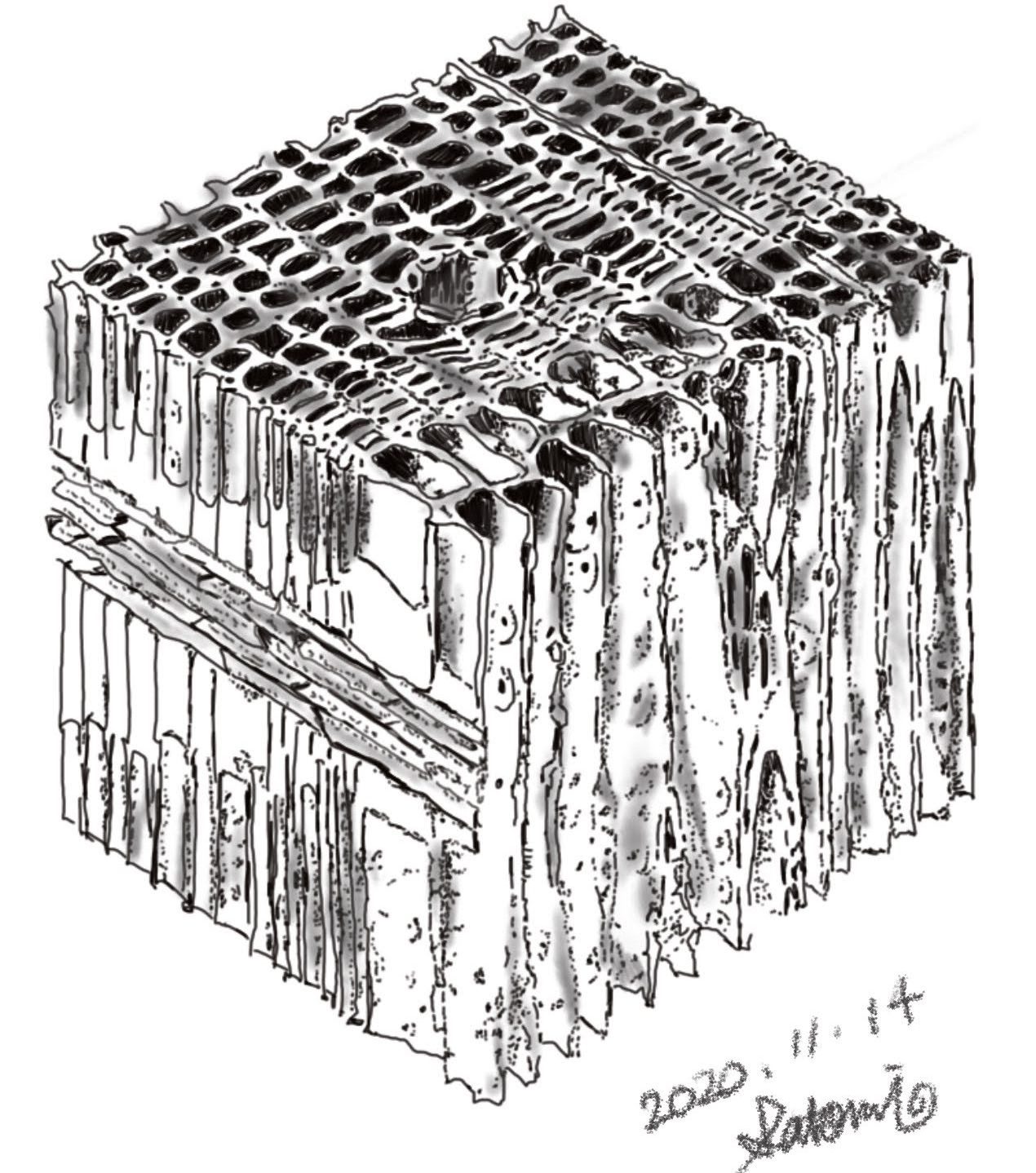

本日、日本きのこ学会誌に投稿した論文(ノート)がパブリッシュされました!33巻2号 p.82-86(2025)です。しばらくすれば、ネットでオープンアクセスで閲覧できるようになるかと思います。その際は内容を更新いたします。
エノキの微細構造について、だいたい予想はついていたものの、見たことなかったでしょう?うふふ!というミニマムな報告となりますのでノートとなりました。しかし、査読付きでございます。
The paper (Note) I recently submitted to the Journal of the Japanese Mushroom Society has been accepted!
It has been just published in Mushroom Science and Biotechnology Volume 33, Issue 3, 82-86 (2025).
This paper will be available as open access in the near future, and I will share the link once it is published. As it is a note written in Japanese, a brief explanation in English is provided below. If you would like to know more or are interested, please feel free to contact me directly.
Although we more or less anticipated the microstructure of Enoki, you hadn’t actually seen it before, had you? Ufufu! This is a rather minimal report, which is why it was published as a note. Nevertheless, it is peer-reviewed.
●内容の紹介●
以下ざっくりですが論文内容を紹介します。後日もう少し分かりやすく修正する予定です。
注)図は学会誌に著作権があります。無断での図の転載はご遠慮下さい。規定によると著者の個人サイトにはokとのことなので今回はいくつか編集して転載しています。
🍄🟫エノキタケの組織構造から食感の秘密を探る!🍄🟫
(実際の論文タイトルとは違います)
わたしたちの研究チームでは、きのこの子実体のバイオベース素材としてのポテンシャルを調査しています。今回は、スーパーでもおなじみの「エノキタケ」の中身(組織構造)と食感(物性)の関係に着目しました。今回比べたのは、一般的な「白いエノキタケ」と、原種に近い「茶色いエノキタケ(カキノキタケ)」です。学名はFlammulina velutipesといいます。


🧬 エノキタケの内部はどうなっている?
エノキタケの柄(えのきの長い“軸”の部分)を詳しく調べてみると、意外なことがわかりました。
※ちなみに今後のサンプルはエノキタケの子実体1本の柄を観察したもので、子実体の束ではありません。よく勘違いされるので念の為。

中心に空洞がある:どちらのエノキタケにも、柄の真ん中にストローのような中空構造がありました。この空洞のおかげで、エノキタケは軽いのに倒れにくいのです。
繊維が長軸方向に配向:菌糸と呼ばれる細長い細胞が柄の長軸方向に沿って並んでいる(配合している)ことがわかりました。また、茶エノキは透明の部分があり(矢印)品種による内部構造の違いが予想されました。

これは、菌糸の横断面の蛍光顕微鏡像です。丸いのは菌糸の横断面です。菌糸の細胞壁を染める染色剤を用いて、菌糸(細胞)の縁を青色に光らせているのです。青色が素敵でしょう✨柄の縦方向に沿って菌糸は並んでいるので、横に切るとぎっしりと丸い細胞が並んで見えるのです。
📏菌糸細胞の特徴
画像解析を行い統計的に品種ごとの特徴を調べたところ以下のことがわかりました。
白エノキ:菌糸の直径が大きく、細胞サイズのバラつきも大きい
茶エノキ:菌糸の直径が小さめ、かつ密度が高い
興味深いことに両エノキに共通して、柄の中心部の方が細胞が大きく、外側にいくほど小さい傾向があることが明らかになりました。
これは、植物の幹にも似た、軽量性と強度のバランスを取る自然の設計だと考えられます。
💪 エノキタケの切れ方の秘密
エノキタケに力を加えて「プチッ」と切れるまでの強さも調べました。下の図の山になっている部分が切れた点になります。ここで興味深かったのは、力をかける方向によって切れ方が違うということです。

柄に対して横向き(垂直方向)に力を加えた場合→ 複数箇所で細かく破断。つまり「プチプチッ」と何度も小さく切れる(左図)。
柄に沿って縦方向(平行方向)に力を加えた場合→ 一箇所で大きく破断。つまり「ブチッ」と一撃で切れる(右図)。
これは、柄の中に並んだ菌糸細胞の向きが関係しています。エノキタケでは菌糸が柄の長軸(縦方向)に沿って並んでいるため、縦方向に引っ張られると、菌糸がまとめて引き裂かれ、横方向から押されると、菌糸が個別にちぎれていくのです。
さらに、白エノキは、破断強度(折れるまでの力)が高く、ばらつきも大きい茶エノキは、横方向に対する耐久力は弱いが、縦方向には強いという違いも明らかになりました。これは菌糸細胞の密度や結合の強さが影響していると考えられます。
🌍 未来への応用可能性
エノキタケの軽さと強さを兼ね備えた構造は、自然が作った高機能な素材そのもの。
これをヒントに軽くて丈夫な緩衝材(クッション材)菌糸ベースのフィルムやシート生分解性の梱包材といった環境に優しいバイオ素材への展開が期待されます。
さらに、菌糸の太さや密度の違いを活かせば、噛みごたえや食感を自在にデザインできる可能性も見えてきました!
📝 まとめ
エノキタケは、ただの食材ではありません。その内部には、軽量性と強度を両立させる自然の知恵が詰まっています。きのこの組織構造と力学特性を深く理解することは、サステナブル社会にふさわしい新しい材料開発への第一歩になるかもしれません!
ちなみに余談ですが、エノキタケが歯に詰まる理由は細長い細胞が密に束なっており、一度で噛み切れないからかなと考えています。組織構造を見ていくことで、食感の秘密が少し理解できた気がしませんか?今回の論文のようなきのこの組織構造シリーズは継続して研究したいと考えています。
★論文情報★
タイトル: 2種のエノキタケFlammulina velutipesの組織構造と力学特性の比較
著者:田川聡美*, 高橋茉那, 中内宙弥, 水野正浩 , 天野良彦
日本きのこ学会誌 (Mushroom Science and Biotechnology), 33(2), 82-86,2025
この論文は当日学部生だった高橋さんのデータを主に使わせていただきました。切片作製で一緒に試行錯誤した思い出が😂ご助力いただきありがとうございました!
● About the Content ●
🍄🟫 Unveiling the Secret of Enokitake’s Texture Through Its Tissue Structure!🍄🟫
Note: Please do not reproduce these figures.
Our research team investigates the potential of mushroom fruiting bodies as bio-based materials. In this study, we focused on the relationship between the internal tissue structure and the texture (physical properties) of the familiar “Enokitake” mushroom found in supermarkets. We compared the common “white Enokitake” with the brown variety, which is closer to the wild type (commonly known as Kakinokitake). The scientific name of both varieties is Flammulina velutipes.


🧬 What’s Inside an Enokitake?
A closer look at the stipe (the long stem part of Enokitake) revealed some surprising features. Note: All subsequent samples were taken from the stipe of a single Enokitake fruiting body, not from a cluster of fruiting bodies.

A hollow center: Both types of Enokitake have a straw-like hollow structure in the middle of their stipes. Thanks to this hollow core, Enokitake mushrooms are lightweight yet resistant to falling over.
Fibers aligned along the longitudinal axis: The stipe was found to be composed of elongated cells, known as hyphae, arranged in parallel to its longitudinal axis. In addition, the brown Enokitake showed transparent regions (arrow), suggesting possible differences in internal structure between the varieties.

This is a fluorescence micrograph of a transverse section of the hyphae. The round shapes are the cross-sections of the hyphae. A cell wall-specific fluorescent dye was used to stain the hyphae, causing the edges of the cells to glow blue—beautiful, isn’t it? ✨ Since the hyphae are aligned along the longitudinal axis of the stipe, cutting it transversely reveals a dense arrangement of these round cells.
📏 Characteristics of Hyphal Cells
Image analysis and statistical comparison between the varieties revealed the following characteristics:
White Enokitake:Larger hyphal diameter with greater variability.
Brown Enokitake: Smaller hyphal diameter with higher density.
Interestingly, in both types, the hyphae near the center tend to be larger, while those toward the outer edge are smaller.
This resembles the structure of a tree trunk and reflects a natural design balancing lightweight properties with strength.
💪 The Secret of How Enokitake Breaks
We also measured the force required to snap the Enokitake (“puchi” sound in Japanese, similar to a soft pop). In the graph below, the peak indicates the point at which the sample broke. Interestingly, the breaking behavior differed depending on the direction in which the force was applied.

Force applied perpendicular to the stipe (from the side) → It fractures at multiple points into smaller pieces — a “pop, pop” kind of break(left fig).
Force applied parallel to the stipe (along its length) → It breaks sharply at a single point — a “snap”(right fig)
This is related to the alignment of hyphal cells inside the stipe.
Since the hyphae are aligned along the longitudinal axis, a force along the stipe tears them collectively, while a sideways force causes individual hyphae to shear off.
Additionally, we found that white Enokitake has higher fracture strength but greater variability, while brown Enokitake shows lower durability against lateral forces but higher strength along its axis.
These differences seem to stem from hyphal cell density and the strength of their connections.
🌍 Potential for Future Applications
The structure of Enokitake, combining lightness and strength, represents a high-performance material created by nature.
Inspired by this, we can envision developing eco-friendly biomaterials, such as lightweight cushioning materials, mycelium-based films and sheets, and biodegradable packaging.
Moreover, by controlling the thickness and density of hyphae, it may even be possible to design the texture and chewiness of food products!
📝 Summary
Enokitake is more than just a food item.
Its internal structure embodies natural wisdom, achieving both lightness and strength.
A deeper understanding of the tissue structure and mechanical properties of mushrooms could be the first step toward creating innovative materials for a sustainable society.
As a side note, I suspect that the reason Enokitake tends to get stuck between your teeth is that its elongated cells are densely bundled, making it difficult to bite through in one go. By examining its tissue structure, don’t you feel we’ve uncovered a bit of the secret behind its texture? I hope to continue this kind of research series on the tissue structure of mushrooms, as in the present study.
★Information of the note★
Comparison of tissue structures and mechanical properties of two strains of Flammulina velutipes
Satomi TAGAWA*, Mana TAKAHASHI, Hiroya NAKAUCHI, Masahiro MIZUNO, Yoshihiko AMANO
Mushroom Science and Biotechnology, 33(2), 82-86,2025
This paper is based primarily on data collected by Takahashi-san, who was an undergraduate student at the time. I have fond memories of working together to troubleshoot the sectioning process 😂. Thank you very much for your invaluable assistance!